

Artists who truly captivate us are the ones who understand the formal rules of their medium and then find ways to push boundaries and surprise the viewer. To this end, we always say: learn the foundational reasons for “the rules” of screenwriting and then make them your own.
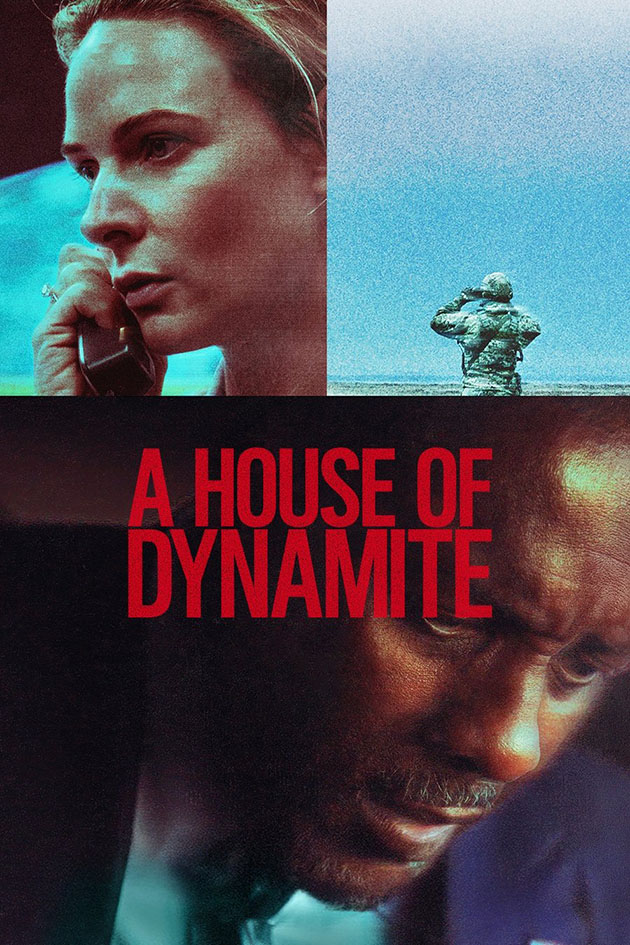
As someone who teaches story structure for a living, I’m fascinated when a story manages to subvert it in a creative way. We can’t watch a movie or TV show without seeing the underlying structure, so we notice when someone does something different. I was fascinated by Kathryn Bigelow’s A House of Dynamite.
 WARNING: SPOILERS AHEAD
In the story, the United States faces the threat of an inbound nuclear missile sent from an unknown source and must grapple with how to respond. In turn, we follow different points of view of intertwined characters, as they move through the twenty or so minutes from detection to impact.
We teach that our Seven Points narrative structure is not a formula, but a reliable tool for organizing story to generate escalating narrative momentum. Thus, I was not surprised that the overall film follows the Seven Point structure, and so do each of the three narrative sub-sections. Essentially, it’s the Seven Point Structure three times, but ending at the Low Point. In this way, the film is like a TV series that has an overall Seven Points guiding the trajectory of the series (or season), and each episode also is defined by its own Seven Points.
The overall Seven Points of the movie provide the super-structure that each section’s narrative and emotional arcs thrive within. They are:
- The Ordinary World of life before the threat.
- The Inciting Incident is the detection of the inbound missile.
- The Point of No Return is to deal with the missile, and the resulting Plan A driving the narrative forward is to figure out how.
- The Midpoint Shift is the GBI’s failure to intercept the missile. As with all good Midpoints, things get much harder and worse after this.
- The Low Point is the confirmation that having exhausted all options, the United States is going to be hit, resulting in mass casualties. The world will be irrevocably changed. A “Dark Night of the Soul” follows, in which the characters decide, in different ways, what to do about it. Who do we want to be if we survive?
- The Final Challenge of implementing that action and finally a…
- New Ordinary World of how life has turned out because of those choices.
Bigelow’s innovation to the Seven Points is that her movie essentially ends shortly after the Low Point. It leaves us—the audience—in the Dark Night of the Soul. In this way, Bigelow challenges us to make up our own minds and decide what our own course of action would be in these circumstances. Even more, she invites us to consider the realistic possibility of a tragedy like the one depicted and what we can do to avoid it.
Now, let’s take a look at the Seven Points for each subsection.
Part 1: Inclination is Flattening
In the first section, we have the happy/harried Ordinary World of Captain Olivia Walker at home and her professional competence as duty officer in the Situation Room. Intertwined with her thread is that of Major Daniel Gonzalez commanding the anti-ballistic missile defense base in Alaska. We see his competence and his struggles with his coworkers due to family complications.
Gonzalez shares his Inciting Incident with the overall film: the surprise detection of the inbound missile which triggers Walker’s Inciting Incident when this report throws her ordinary day in a new direction. They share the same Plan A at the Point of No Return: to get to the bottom of the incident and implement the best strategy to deal with it. Walker initiates a conference call with key power players to inform and strategize. We will see this call repeatedly throughout the film from different points of view.
Walker’s Midpoint Shift is the failure of international calls for diplomacy resulting in potential enemy governments deploying their own forces in anticipation of nuclear war. Gonzalez’ Midpoint Shift is the order to launch two missiles, GBIs, to destroy this threat. There is no margin for error. As with all solid Midpoint Shifts: things will get harder and worse for our characters after this.
Walker’s Low Point is the hard truth that the target is the Chicago area. Gonzalez’ Low Point is the failure of the GBI missiles to take out the threat. With essentially nothing further to do, Gonzalez’ story ends in its Low Point. DEFCON is raised to level 1.
In the Dark Night of the Soul that follows, Walker makes a desperate call to implore her husband to leave the city with their son. She must ask the President for orders on launching a retaliatory strike. While not one of the Seven Points, The Dark Night of the Soul often follows the Low Point as a character faces hard truths and becomes who they need to be to face their Final Challenge.
Part 2: Hitting a Bullet with a Bullet
In the second section of the film, we see the same story through the perspective of General Anthony Brady and that of National Security Advisor Jake Baerington, both participants in the recurring conference call.
In their Ordinary Worlds we get Baerington’s happy home life and pregnant wife, while Brady’s confident in his leadership and strong career. We head right into the Inciting Incident (the missile is detected) with Brady joining the security conference call in an underground command bunker while Baerington scrambles to handle the call during his harried commute.
Brady’s and Baerington’s Point of No Return is the same as Walker and Gonzalez: to get a handle on the situation and implement the best plan. When they learn of the GBI’s failure, Brady argues for retaliation while Baerington advises calm diplomacy. These two thereby represent opposing schools of thought in dealing with the threat. Baerington reveals what we already know: the missile defense system is far less effective than we want to believe. The reveal of the desperate options after the GBI’s failure shifts the intensity of the story, representing the film’s overall Midpoint Shift.
Baerington’s Midpoint Shift is when he’s tasked with speaking with the Russian Minister of Foreign Affairs in place of the President. Brady is presented with nuclear strike options and counsels the President to listen to his commander who carries the nuclear football. Baerington’s Low Point is his failure to get a non-retaliation promise from the Russians which he must then relate to the President. However, ever the optimist, he holds the line that retaliation would be suicide.
Meanwhile, Brady’s Low Point is failing to get a clear answer and plan from the President. In grappling with this dire situation through his Dark Night of the Soul, he must put protocols in place if the President fails in his duty. Brady authenticates the President’s launch codes and asks for orders on a retaliatory strike.
Part 3: A House Filled with Dynamite
The third section of the film centers on Secretary of Defense Reid Baker and the President himself, until now a vague figure. With a deft Ordinary World, we learn that Baker’s wife recently died and he’s estranged from his daughter. We also learn that the President has a strong relationship with his wife who is on a conservation project in Kenya.
For both, the Inciting Incident is learning of the inbound missiles; Baker via the conference call, the President while being evacuated from a WNBA clinic press event. Now knowing that impact will be in the Chicago area, they share the same Point of No Return Plan A as everyone else: they must figure out what to do. Baker tries desperately to reach his estranged daughter in Chicago.
Their shared Midpoint Shift is the counter measure’s failure to intercept the missile. This is now more serious than either man is ready to accept. Baker’s Low Point is that upon reaching his daughter and learning of her happy new relationship, he can’t let her final moments be of panic and fear; he doesn’t reveal the horrible truth to her. In his Dark Night of the Soul, he then commits suicide by walking off the Pentagon roof instead of evacuating. Though he has the option, he doesn’t want to live in a world that doesn’t contain her. As part of the film’s overall Low Point, this confirms that there is no way out of this situation. No happy ending is possible.
Meanwhile, the President hears Baerington’s perspective on non-proliferation while his officer with the nuclear football counsels him on attack options. His Low Point is when, faced with a difficult decision, he reaches out to his wife to share this horrible truth. In his Dark Night of the Soul, the President rejoins the conference call and confirms his launch codes with Brady.
Each section features (at least) two perspectives on the crisis and follows two different paths. Each features characters with high personal stakes on top of the high global stakes of the situation—all key ingredients in creating effective and propulsive narrative tension.
What is anyone’s Final Challenge? We cut before we learn the President’s ultimate decision. The warhead’s impact is implied by the sound of explosions heard from an underground bunker where various characters have been evacuated, but we don’t learn what the President chose or where the nation or the world will go from here.
Effectively, Bigelow leaves us all in a Dark Night of the Soul to contemplate the stakes of a very possible real-world circumstance. She engineers a structure that repeats yet shifts three times, never once giving us a concrete Final Challenge or ultimate New Ordinary World outcome. Whether or not the film itself is your cup of tea, I applaud her innovative and unusual approach to structure. She took the basics, elevated them, and made them her own.
Want to learn how to integrate and elevate the Seven Points story structure in your own work?
Check out our upcoming online programs and residential labs.
As always, we’re also ready to support your process with intensive one-on-one coaching and script feedback.
Your next project is worth it.