

by Carlo Cavagna
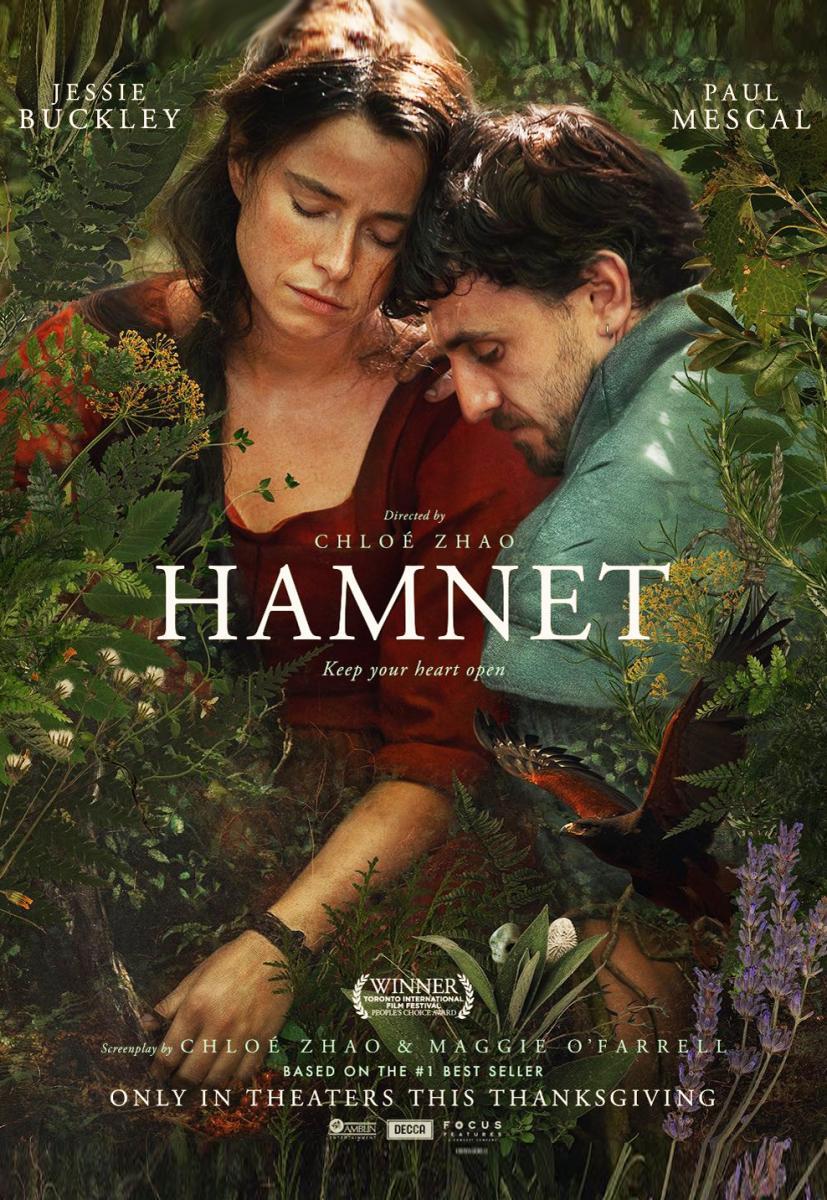
Hamnet, one of the most critically lauded films of 2025, speculates on the inspiration for the greatest tragedy ever written—Shakespeare’s Hamlet—but unusually Shakespeare (Paul Mescal) himself is often in the background of the film. Instead, the movie stays with the point of view of his wife Agnes (Jessie Buckley) in their home in Stratford, as Shakespeare disappears for long stretches to build his career in London.
Warning: Contains SPOILERS for HAMNET
If we adhere to the typical definition of a protagonist, Agnes is an unusual one. She does not make most of the choices that drive the narrative. Though strong and independently minded, Agnes is nevertheless forced into the role of a turn of the 17th-Century housewife. She makes only two significant decisions: to be with Shakespeare, and in the wake of their mutual tragedy, to go to London to see Shakespeare’s play.
It is Agnes’s character arc that powers the film, yet it is Shakespeare who makes most of the choices that drive the narrative, even though we experience many of his choices only obliquely. The Final Challenge, for example, consists of him creating and staging Hamlet as a way to process his grief, but we never see him deciding to write it or experience the work he put into it.
With this strange dichotomy, how does Hamnet manage to pack a wallop by the end? Using our PageCraft tools, let’s take a look at the narrative Seven Points, which define the external events and belong to Shakespeare, followed by our Character Arc analysis, which define Agnes’s internal journey.
The Seven Points (Shakespeare)
- Normal World: Young Shakespeare works as a Latin tutor in his hometown of Stratford, though his writing talent is already evident.
- Inciting Incident: Shakespeare meets Agnes as she practices falconry and earns a kiss.
- Point of No Return: Marrying Agnes after impregnating her, Shakespeare decides that he will try to balance family life in Stratford while pursuing a playwriting career in London, which keeps him away for long stretches.
- Midpoint: The plague hits England.
- Low Point: Before Shakespeare can make it back home, their son Hamnet appears by magical realism to take his plague-stricken sister Judith’s place, and he dies. Shakespeare is devastated. He further strains his marriage by departing for London again. His plan to balance family and career has failed.
- Final Challenge: Shakespeare must process his grief, which he does by writing and staging Hamlet, which unexpectedly allows Agnes to process her grief as well when she shows up to see it.
- New Ordinary World: Seeds are planted for a healed relationship between Shakespeare and Agnes.
Character Arrow (Agnes)
- Mask: Agnes is seen as a crazy forest witch by the Stratford villagers.
- Wound: Agnes is an orphan and an outcast who has not experienced connection to people.
- Strong Suit: Agnes’s “forest witch” skills: she is an independent falconer who knows home remedies and has a kind of second sight.
- Trouble Trait: Agnes often lashes out at people in anger, straining the connections she does have.
- Dark Side: Trapped by her grief, Agnes can end up embittered and alone.
- True Self: Having experienced catharsis, Agnes is ready to re-engage with the world.
So how does Hamnet work so well when the Seven Points primarily belong to one character and the Character Arrow to another?
It’s important to note that Agnes does have her own Seven Points, even if they are not quite as strong. And Shakespeare does have his own Character Arrow; it’s just more in the background. Taking Agnes first, the decision for she and Shakespeare to be together is mutual. Later, Agnes does encourage Shakespeare to go to London for his playwriting career, so she has some ownership over her situation. Plus, the choice to go to London to see Hamlet is a big one—Agnes has never been far from Stratford. Furthermore, the script repeatedly underscores that Agnes does have some agency, as she constantly must defend her choices to her stepmother, mother-in-law, and other critics. As for Shakespeare, his character arc is not dissimilar from Agnes’s. His mask (troubled artist who thinks he’s too good for hard work) and obviously his Strong Suit (beautiful words) are different, but he must undergo a similar journey through his grief.
Now we have two Character Arrows and two sets of Seven Points. Based as they are on similar events, the movie intertwines them so closely that it doesn’t really matter that one Arrow and one set of Seven Points are primary, because both characters are journeying together—even when they are apart. In fact, much of Agnes’s catharsis in the Final Challenge comes from finally understanding that her husband has been going through the same pain, to the point that he shares it with the whole world, causing us all to experience it—and the resulting catharsis—with him. Because that sharing takes the form of the world’s most famous play, it becomes a stunningly resonant sequence.
At the end, Hamnet becomes a film about the creative moment, in this case the writing of Hamlet. But, as many artists will tell you, creative moments are inexplicable. Inspiration just comes… from somewhere. Hamnet is the latest film to prove the best way to show the creative moment is not by attempting to depict it, but by creating a story around the inspiration for it. Because the audience experiences the inspiration, it therefore gains insight into the moment itself. Congratulations to writer/director Chloé Zhao and writer Maggie O’Farrell (who also wrote the novel) on a masterful film.
Want to learn how to integrate the Seven Points and Character Arrow in your own work? Check out our upcoming online programs and residential labs.
As always, we’re also ready to support your process with intensive one-on-one coaching and script feedback.
Your next project is worth it.