

A small slice of history, a strong Character Arrow, and the tension of being wrong
I’m a sucker for a World War II story. It’s an era that has always fascinated me, so much so that a few years ago I was an Austin Film Festival pitch competition finalist with Spitfire, my series about the women who flew for Britain’s Air Transport Auxiliary. Heroes, all. Call me, Tom Hanks.
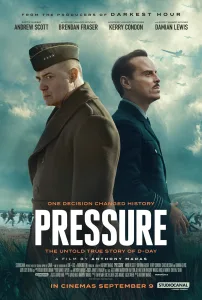
But with so many World War Two stories already told, how do you find something fresh to say? Anthony Maras’s Pressure, starring Andrew Scott as British meteorologist James Stagg and Brendan Fraser as General Eisenhower, offers a useful answer for writers: choose a small slice of a big story, then find the emotional journey inside it.
WARNING: SPOILERS AHEAD
 Find the angle we haven’t considered
We tend to think about D-Day in terms of military strategy, landing craft, and soldiers on beaches under heavy gunfire. Pressure centers something less glamorous but more essential: the weather.
Eisenhower needs to know if weather conditions will allow the invasion to proceed. Stagg has to give him an answer. Aircraft need visibility. Landing forces need manageable seas. An extraordinary military operation depends on people interpreting data and making a forecast, and the longer Eisenhower waits, the more likely it is that the Germans will figure out what they’re doing.
It makes perfect sense. It just wasn’t a part of the story I had thought much about, possibly because today we carry weather forecasts around in our phones and barely consider the expertise behind them. Here, that expertise carries an almost unimaginable responsibility.
A fresh perspective doesn’t have to overturn everything we know about an event. It can bring an overlooked person, decision, or detail into focus. Nuremberg approaches familiar history through the exchanges between a psychiatrist and a war criminal. Pressure finds its drama in weather charts and the people arguing over them.
If you’re writing about something we already have a lot of stories about, narrowing your focus can help. Who have we overlooked? Which apparently minor decision made everything else possible? Find and consider the story of the person who made that key difference.
We know the outcome. We don’t know the emotional journey.
Eisenhower’s team plans to invade on June 5. We know D-Day happened on June 6. So how does Pressure keep us engaged when history has already given away the ending? Through the people who have to make the decision without our hindsight.
At PageCraft, we look at how our seven-point story structure works alongside the Character Arrow, our map to the internal character journey that gives the external events emotional meaning. In Pressure, the demands of the mission press Stagg’s emotional triggers. His expertise makes him essential. His way of dealing with people makes an already difficult job harder.
His MASK is apparent from the opening: serious, rigid, and prickly. He struggles to say a warm and loving goodbye to his pregnant wife. Arriving at the Allied command center, he won’t engage with the mission team’s ease and camaraderie. Yet we glimpse his longing to participate in it.
That matters, because we need to see the possibility of Stagg’s TRUE SELF before he can reach it. His TROUBLE TRAIT is perfectionism, expressed with little regard for other people’s comfort. His STRONG SUIT is equally clear: he’s very good at his job, and he cares deeply about getting it right. Growth won’t require him to surrender that strength, but it will require him to add something to it.
American meteorologist Irving Krick becomes his central opponent. Their competing methods and forecasts create the external conflict, but their differing temperaments makes it personal. Each is absolutely convinced he is right.
At the MIDPOINT, Eisenhower gives them a deadline: it’s midnight, and they have four hours to deliver a final answer. The ticking clock tightens the plot while exposing more of Stagg’s DARK SIDE. He undercuts and shames Krick. His insistence on getting things right becomes an insistence on having things his way.
Anger looks like his obstacle. Underneath it, I read something more interesting: fear. What if he’s wrong? His emotional walls suggest a WOUND of abandonment, a need to protect himself from depending on others. Whether or not we name that wound, the behavior is legible: he grasps for control when connection might leave him exposed.
Meanwhile, the mission demands a certainty his science cannot offer. Again and again, he’s asked whether he’s sure. Again and again, he has to acknowledge uncertainty. That’s a fascinating contradiction to build a character around: a perfectionist whose professional responsibility is to make an imperfect prediction.
The LOW POINT follows what should have been a victory. Eisenhower sides with Stagg and postpones the invasion. But when the day Stagg predicted would be stormy dawns sunny and balmy, winning the argument becomes a source of devastation. His refusal to join the others at the church service gives us a visual expression of his isolation. They have somewhere to turn. He remains alone with the possibility that he has failed.
Then the rain arrives. The important change isn’t simply that Stagg was right. It’s that he now understands what being wrong means for Krick. Vindication creates an opportunity for empathy.
As the film moves into its FINAL CHALLENGE, Stagg brings Krick into the search for a usable window in the storm. He collaborates and lets Krick make the call. We see his TRUE SELF emerge: still rigorous, but more grounded and willing to trust. When Eisenhower again asks whether he’s sure, Stagg can commit. He hasn’t acquired perfect knowledge, but he has become able to take responsibility without it.
For writers, that’s the craft lesson: make the external challenge demand the very behavior your character finds most difficult. Stagg needs to help deliver a forecast. To do that, he also needs to change how he works with people.
Accuracy versus emotional truth
Historical events rarely arrive with tidy act breaks and conveniently timed personal crises. Writers have to shape them.
Pressure brings Stagg’s wife’s pregnancy to its culmination around D-Day, although the birth really happened months later. The change juxtaposes his personal fears with his professional responsibility. He’s being asked to protect thousands of strangers while unable to be with the person he loves.
Bohemian Rhapsody makes a comparable choice by placing Freddie Mercury’s diagnosis before Live Aid, although it came afterward. That changes how we experience the performance: triumph now carries the weight of mortality.
You can debate whether either choice earns its emotional effect. I think Pressure uses the personal timeline effectively to make Stagg’s divided responsibilities immediate. But emotional truth deserves scrutiny too. Moving a date can help express an experience; it can also change what we believe caused an event or motivated a person. Making us feel something isn’t, by itself, proof that the choice works.
It also helps to distinguish the film’s Character Arrow from a claim about the historical man. The real D-Day forecast was a collaboration among multiple teams, with a Norwegian named Sverre Petterssen most responsible for predicting bad weather and Stagg responsible for sifting and coordinating among the competing forecasts. Instead the film concentrates that work into a personal conflict we can follow and an emotional change we can see.
The useful question for a writer is: what do the historical alterations reveal, and what might they distort?
Pressure gives us a focused external problem and a character whose strengths and emotional defenses collide with it. We know when the invasion will happen. We still want to see how this man will become capable of helping it happen.
Find your small slice of a larger story. Then put your character under the kind of pressure that makes staying the same impossible.
Want to strengthen the relationship between your story structure and your character’s emotional journey? Check out our upcoming online programs and residential labs.
As always, we’re also ready to support your process with intensive one-on-one coaching and script feedback.
Your next project is worth it.